Resources
The Rise of AI Search: A Timeline
Google’s AI Overviews didn’t exist three years ago. Now they’re reshaping how people find businesses, and most business owners have no idea it’s already happening to them.
This isn’t a future trend to prepare for. It’s a shift that’s already underway, with real, measurable effects on how customers discover businesses like yours. Here’s the actual timeline, what the data shows, and what it means if you haven’t thought about AI search optimization yet.
What Is AI Search, and Why Should Your Business Care?
When someone searches Google today, they increasingly don’t see a list of blue links first. They see an AI-generated summary, an AI Overview, that answers their question directly, often pulling from multiple sources and citing a handful of them. The same shift is happening across ChatGPT, Perplexity, and Gemini, where people are asking questions directly instead of searching and clicking through.
This has given rise to two closely related disciplines: Generative Engine Optimization (GEO) and Answer Engine Optimization (AEO). Where traditional SEO optimizes a page to rank in a list of links, GEO and AEO optimize a business to be the thing an AI engine actually cites, or recommends, when it answers a question.
For small businesses, this matters more than it might seem. If an AI assistant is the one telling a potential customer which local business to call, being invisible to it is the modern equivalent of not showing up in search results at all.
The Timeline: How We Got Here
AI-powered search has moved fast, faster than most businesses have been able to track. Here’s the real sequence of events:
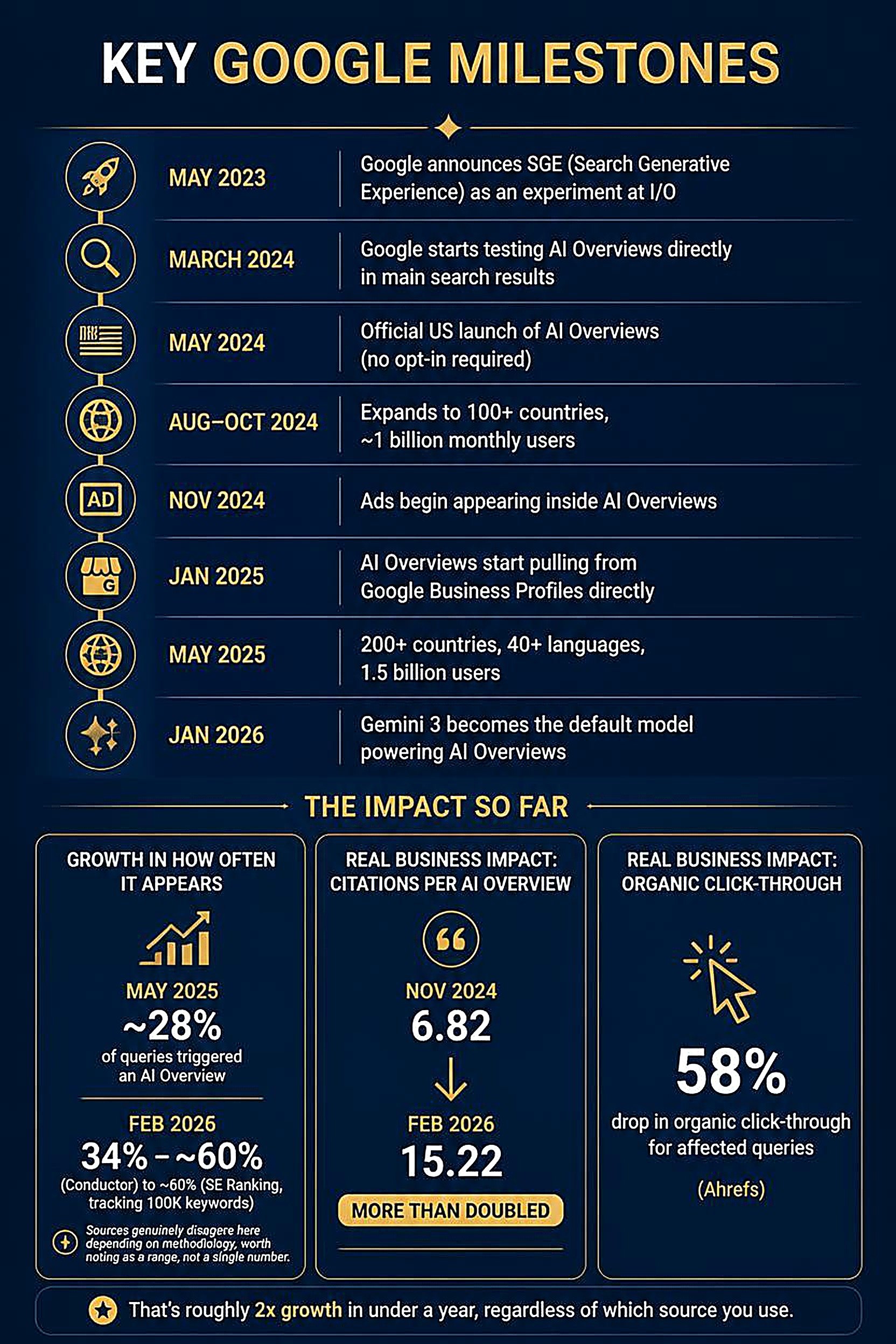
- May 2023 — Google announces the Search Generative Experience (SGE) as an experiment at Google I/O, an early, opt-in test of AI-generated search summaries.
- March 2024 — Google begins testing AI Overviews directly in main search results, no longer limited to opted-in users.
- May 2024 — Official U.S. launch of AI Overviews, live by default for everyone, no opt-in required.
- August–October 2024 — Rapid international expansion to over 100 countries, reaching an estimated 1 billion monthly users.
- November 2024 — Ads begin appearing directly inside AI Overviews, a signal that Google now treats this as core infrastructure, not an experiment.
- January 2025 — AI Overviews start pulling information directly from Google Business Profiles, meaning your business listing itself becomes a data source AI can cite.
- May 2025 — Global reach expands to 200+ countries and 40+ languages, with 1.5 billion monthly users.
- January 2026 — Gemini 3 becomes the default model powering AI Overviews, improving accuracy and expanding what kinds of questions it can answer well.
Three years. That’s the entire history of a technology that now shapes a meaningful share of how people search.
The Impact So Far
The timeline explains what happened. These numbers explain why it matters.
AI Overviews are showing up far more often, far faster. In May 2025, an estimated 28% of search queries triggered an AI Overview. By February 2026, that had grown to somewhere between 34% and 60%, depending on which research firm measured it (Conductor and SE Ranking, respectively, using different methodologies and keyword sets). Even taking the conservative end of that range, it’s roughly double in under a year.
AI Overviews are citing more sources than before. The average number of links cited inside an AI Overview grew from 6.82 in November 2024 to 15.22 by February 2026, more than double. That’s a meaningful shift: being one of a handful of citations is a very different opportunity than being one of fifteen.
Traditional organic clicks are dropping for affected searches. According to research from Ahrefs, queries that trigger an AI Overview have seen at least a 58% reduction in organic click-through, since many users get their answer directly from the summary and never click through to a website at all.
But the traffic that does come from AI search converts better. Multiple independent studies converge on a striking pattern: visitors referred by AI search platforms convert at roughly 2x to 9x the rate of traditional Google organic traffic. The theory behind this is straightforward: by the time someone clicks through from an AI-generated answer, the AI has already summarized what your business offers. They’re not browsing anymore, they’re validating a decision they’ve functionally already made.
Put simply: fewer people are clicking through from search overall, but the ones who do, especially from AI platforms, are far more likely to actually become customers.
Why This Matters for Small and Local Businesses
If you run a nonprofit, a therapy practice, a real estate business, or a trades company, this might sound like something that only applies to large tech-forward brands. It doesn’t.
AI Overviews now pull directly from Google Business Profiles. That means your business listing, your reviews, your services, your hours, is increasingly a data source AI is reading and citing when someone nearby asks a question like “who’s a good [your service] near me” or “what should I look for in a [your industry] provider.” If that listing is incomplete, outdated, or inconsistent with the rest of your online presence, you’re not just harder to find on a map, you’re harder for AI to recommend at all.
The same logic applies to your website and your content. AI engines favor businesses with clear, structured, factual information, real answers to real questions, not vague marketing language. A site built with AI visibility in mind (structured data, clear FAQs, consistent and accurate information across platforms) has a real advantage over one that was never built with this in mind.
What You Can Actually Do About It
You don’t need to become an SEO expert to respond to this shift. You need to know where you actually stand, and that starts with an honest look at your current online presence, your website, your Google Business Profile, your social channels, seen through the lens of how AI search actually reads and cites businesses today.
This is exactly what our free audit checks for: not just whether your website looks good, but whether your business is actually visible to the search tools your customers are already using. Get your free audit →
Sources: Ahrefs, Conductor, SE Ranking (100K keyword tracking study), Synscribe, SEOScaleUp, TDMP, Google I/O announcements (2023–2024).
Frequently Asked Questions
What is GEO (Generative Engine Optimization)?
GEO is the practice of optimizing a business's online presence so AI platforms like ChatGPT, Perplexity, and Gemini cite or recommend it when answering a user's question. It's the AI-era counterpart to traditional SEO, instead of ranking a link, the goal is being part of the AI-generated answer itself.
What is AEO (Answer Engine Optimization)?
AEO is closely related to GEO and focuses specifically on being featured in direct-answer formats, like Google's AI Overviews and featured snippets. The two terms are often used interchangeably; AEO leans toward answer engines like Google, while GEO leans toward generative chat platforms.
Do I need a website for AI to recommend my business?
A website helps, but it's not the only source AI search draws from. AI Overviews increasingly pull directly from Google Business Profiles, meaning an accurate, complete profile matters even for businesses without a website yet, or as a strong starting point alongside one.
How is AI search different from traditional Google search?
Traditional search shows a ranked list of links for a user to click through. AI search generates a direct answer, often citing a handful of sources, meaning users may never click through to a website at all. The businesses cited in that answer get the visibility; the rest don't.
Can a small business actually compete for AI visibility against larger brands?
Yes. AI platforms cite based on how clearly structured, accurate, and specific a source is, not on brand size or ad budget. A well-optimized local business profile and website can be cited over a larger competitor with a less accurate or less structured online presence.